Friday, 6 January 2017

1066 Harold's Way - the Website


Imagine 1066, the Battle of Hastings and King Harold’s epic journey to his date with destiny.


Imagine being part of King Harold’s army, did it rain, was it dry? Three days of marching, the nights were drawing in, the noise, the fear and a battle to face – a camp at Rochester, a camp at Bodiam and a final climb to Caldbec Hill.


The 14th October 1066 is one of the most emotive dates in English history and Harold’s march to the Battle of Hastings is the stuff of legends.


You too can follow in King Harold’s footsteps, along his most likely route to the Battle of Hastings, by walking 1066 Harold’s Way, a walk that starts at Westminster Abbey and finishes at Battle Abbey, East Sussex.


Accessible by public transport, there is nothing to stop you sharing the experience of 1066 Harold’s Way, through London, Kent and East Sussex.


The guidebook for this 100 mile long distance walk is readily available from Waterstones, Amazon, Foyles and other bookshops.

Find out more HERE

http://www.1066haroldsway.co.uk/home-cw7

AWARD winner

Our author Michael Evans has won a prestigious local award for his book "East Anglia at War".

Monday, 12 December 2016

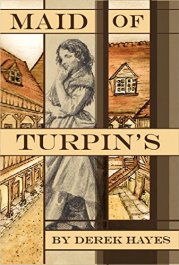
An Interview with Derek Hayes, author of Maid of Turpin’s


As regular Linda’s Book Bag readers know, I’m always happy to support less well known authors and publishers so it gives me great pleasure to introduce Derek Hayes today. Derek’s latest book  Maid of Turpin’s was published by Bretwalda Books on 16th July 2016. Maid of Turpin’s is available for purchase here.

Maid of Turpins

better-cover
Young Sybil Turpin is an innkeeper who caters for the unsavoury underworld of 18th Century London. When she gets involved in a fiendish plot about spies and political intrigue her life is suddenly in danger from the most ruthless of men.
The year is 1720 and the government of Prime Minister Robert Walpole is overwhelmed by a criminal scandal which threatens to bankrupt the country. Richard Hamilton secret agent of the crown is sent to investigate. The story centres around the notorious tavern in Honey Lane; a lawless neighbourhood within Cheapside.
Turpin’s is ruled by a feisty young Sybil Turpin; an eccentric character who bathes daily in a hogshead barrel and rides like a highwayman.
She and Richard, himself an unconventional character, start as adversaries but when more brutal criminal activity unfolds, they join forces and their quest leads them around the streets of London, from Tyburn to the Bank of England; through Vauxhall Pleasure Gardens to a prison vault under London Bridge.
Richard Hamilton may have met his match with this bold young woman but the Maid of Turpin’s has a further challenge ahead, far beyond her comprehension or ability.

An Interview with Derek Hayes

Hi Derek. Thank you so much for agreeing to answer some questions on my blog about your writing. Firstly, please could you tell me a little about yourself?
I’d describe myself as a well-fed bookworm, people-watcher, storyteller and an expert at make believe. They are lifelong attributes and still as useful now as they ever were. I read a lot and have quite diverse tastes. I usually have two or three books on the go at the same time.
I was a child of the fifties, but I hasten to add a very young one. I live in Wiltshire with my wife Jennifer and lots of grandchildren nearby; still able to indulge the story telling.  I spent most of my working life in the NHS and that was where the people-watching began. It was always a privilege being present through the critical times of other people’s life experiences; often of the dramatic and terminal kind. But then there was hospital humour; usually itself profoundly unnerving but always a palliative for the distress and sadness. Experience enough for several lifetimes.
(I bet!)
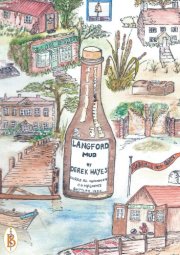
And tell us a bit about your Langford series of books.
mud
This is where the people-watching became reality for me. Set in the 1950s Langford Follies are a study ...

You can read the entire interview HERE

https://lindasbookbag.com/2016/12/10/an-interview-with-derek-hayes-author-of-maid-of-turpins/

Friday, 2 December 2016

First ebook sale of December - Winter God: The Authorised Biography of Father Christmas

Buy your copy HERE

Some people call him Father Christmas, other people name him Santa Claus, but whatever name he goes by we all know him.
He is the jolly, fat man who comes out only on Christmas Eve. He loads his sleigh up with toys for all the good children in the world. He wraps himself up in a warm, fur-lined suit of red cloth with matching hat and warm black boots. Then he hitches up his magic flying reindeer, leaves behind his workshop at the North Pole and takes to the skies. For hours he gallops across the wintry, frozen landscapes to bring toys to millions of excited children around the world.
He has become the living embodiment of the Christmas Spirit. But where did this loveable old boy come from? How old is he? Has he always been so jovial? And what about the elves, reindeer and North Pole?
Many people think that Santa was invented for an advertising campaign by Coca Cola. Others date him to Victorian times. A few may place him back in the 18th century or even Tudor times. But they are all wrong.
He is much, much older than that.
This book traces the development of our favourite Christmas character from his origins many centuries ago down to the present day. We learn when and how he started giving presents to children, why he is so fat and where the reindeer came from - among many other things.

Saturday, 26 November 2016

A History of Christmas Food - new ebook out now

- With over 20 historic recipes


Buy the ebook HERE

Christmas today is a time of feasting, drinking and all round merrymaking. We serve vast meals that cause our dining tables to groan with the weight and our families to gasp at the luxury.
But it is not just a matter of serving huge meals. Christmas - more than any other time of year - is associated with its own special foods, drinks and eating customs.
Most Christmas foods are widely recognised. Roast turkey graces most tables, which also feature sprouts, roast potatoes, parsnips, bacon rolls, pigs in blankets, cranberry sauce and bread sauce. All that is in due course cleared away to be replaced by Christmas pud and mince pies.
Others are very personal. I grew up in a household where supper on Christmas Eve was always sausages and mash, and where the adults began Christmas Day by trooping down to the kitchen for "Grandma's Special Christmas Tea", which was consumed with much lip smacking and joking. As a tot I found this early morning ritual a bit odd, but when I grew older I learned that "Grandma's Special Christmas Tea" involved my grandmother tipping a healthy dose of whisky into each mug before pouring out the tea.
We take so much of this for granted as part and parcel of our Christmas traditions that we indulge ourselves without thinking. And if we do spare a thought we probably imagine that Christmas has always been like this.
But it hasn't. Christmases of years gone by were very different. Oh, there has always been plenty of eating and drinking going on, but what has been eaten or drunk has varied enormously.
So what did our ancestors eat and drink on the greatest feast of the year?
Read on.

Please note that in producing the recipes included in this book I have adapted original recipes found in books and manuscripts dating back to the times in question. Earlier recipes often did not include either precise measurements or detailed instructions, so I have experimented to find what seems to work best for me. I have generally sought to avoid recipes using ingredients that might be difficult to find these days or have suggested easily obtained alternatives when I have - how could I possibly miss out Mrs Beeton's original Christmas cake of 1861? Enjoy trying out these recipes and your taste of the past.

Wednesday, 20 May 2015

Review of "Once a Priest"

This just in from a reader:
I am recovering from a serious case of metaphorical post coital triste after reluctantly turning over the last
page of your wonderful Once a Priest.It was one of those reads which you wish would never end.

A few comments by way of appreciation which cannot do justice to the integrity of the book as a whole and its
'omniscient'and energetic narrator.

*I was struck by the explosive first page or two which must be a model for how to begin a work.You have parachuted
into the sixties Liverpool in the most intense and realistic fashion which no social historian could hope to accomplish;
capturing the mantras as you propel the actors onto the stage.This is finely honed economic prose rattling its
cage to become poetry.

*Having been a prisoner of the Brent asylum of the terminally mad at the same time as you were in Bolton,I was
particularly struck by your descriptions of the admin apparats in the grip of a plague of wrongheadedness.I was
 touched by your encounters in the classroom;the pupils;always  powerless victims of the top down poison
administered by our heavily politicised educational state educational apparatus.Your survival stratagems would
make an excellent survival guide for any youngster brave enough to enter the educational fray.

*Sauced with Chaucerian wit throughout

*marvellous insight into the inner workings of the C of E, which despite Trollope, has always for me, been veiled in
mystery.

*Counterpoint.You achieve some well judged a**e kicking in your relentless pursuit of humbug.Yet there are sensitive
episodes of real poignancy.The death of Louie which you were privileged to attend.."I watched her dying......It was like
watching someone being born.She made a good job of it,such fun of it.That was one of her expressions"The nurse."That
woman"she said."That woman-she was an angel!"

*Remarkable capturing of local language idiosyncrasies...."It weren't bad......it were alreet..."the leaden vice of Leeds.I
think it was Lord Salisbury said "Always believe in stereotypes"And the memorable "affat"...And after 'Romeo and Juliet'
"Will we affat write about it tomorrow.....?.....not forgetting "allus"The Dickensian Broadstairs "Have a look at....."the
girl guides etc

*Such a variety of characters as if you were in receipt of an EU rights injunction to include them all!The maverick James....
I am looking forward to hearing more about him and the Uriah Heap senior curate, destroying the bogs with his bike.Characters galore, like a Dutch painting ,and like Shakespeare,minor characters all have their importance.

And the land and townscapes so economically and memorably delineated...

*Then the style;varied but always moving musically as the book progresses;fusing naturally into poetry at the most
appropriate times

*This book is no trivial self indulgence.It takes on the big subjects.Most of all God,worship,prayer,salvation.And the forces
that militate against the latter.Imposters in the Church.The real danger of the abuse of power in the charismatic movement
The age old evils of those who seek preferment by aligning themselves with secular government and the zeitgeist, neglecting their flocks.

*The unity of this marvelous book;the narrator;cheerfully, courageously,overcoming difficulties,armed with that life saver, a sense of irony.Once a priest and by the grace of God,always a priest!

Much much more to say

In appreciation

Yours

Paul

Get your copy HERE

http://www.amazon.co.uk/Once-Priest-Peter-Mullen/dp/1910440116/ref=sr_1_1_twi_1_pap?s=books&ie=UTF8&qid=1432126179&sr=1-1&keywords=once+a+priest+bretwalda

Friday, 1 May 2015

First Ebook sale of the month - East Anglia at War

First Ebook sale of the month - East Anglia at War

In both world wars the British confidently expected Germany to mount an invasion through East Anglia. During the Great War enormous numbers of troops, who were desperately needed on the Western Front, were tied up defending East Anglia against an invasion that never came. In spite of this, in World War II, once again it was East Anglia where the confidently predicted German invasion would take place.
In both Wars East Anglia was a hive of activity with soldiers, sailors and airmen frantically preparing for an invasion that never came, and latterly striking back at Hitler’s Reich through RAF Bomber Command.
This book looks at East Anglia in those desperate, bloody years. It shows how the people of the area coped and survived, or sometimes made the ultimate sacrifice. The book also looks at the relics of those years - gun emplacements, airfields and other structure built while East Anglia was at War.

Contents
Foreword
Chapter One – The Scene is Set
Chapter Two – Encore Une Fois
Chapter Three – The Agricultural Revolution
Chapter Four– The Beginning
Chapter Five – When will they arrive?
Chapter Six –The German invasion plan
Chapter Seven – Local Organisation
Chapter Eight - The Home Guard
Chapter Nine – Military Readiness
Chapter Ten - The RAF before the Battle
Chapter Eleven – The Battle of Britain Begins
Chapter Twelve – The fight to the Death, Douglas Bader and the Big Wing
Chapter Thirteen – Some Iconic Airfields of East Anglia
Chapter Fourteen – The American Intervention – The early Days
Chapter Fifteen – US in Britain
Chapter Sixteen - Keeping the North Sea Open
Chapter Seventeen – Air Raids
Chapter Eighteen – And Finally

About the Author

Michael’s home is in East Anglia. After many years based near Cambridge, he now lives close to the North Norfolk Coast.

Always a prolific writer, during more than twenty years as a head teacher he managed to combine his writing activities with running a school. Educational writing continues to play a significant part in his output, but he has also written widely on topics relating to 20th century military history. This book combines his interest in military history with his love of East Anglia.

This is Michael’s twelfth book and his third covering a World War II topic. The other two: RAF Duxford and Douglas Bader were both published as part of Bretwalda’s Heroes of the RAF series.

Get your copy HERE
http://www.amazon.co.uk/East-Anglia-War-Michael-Evans-ebook/dp/B00TEBI8KU/ref=sr_1_1?s=digital-text&ie=UTF8&qid=1430547896&sr=1-1&keywords=East+Anglia+at+War