Wednesday, 25 January 2017
NEW BOOK - The Coronations of King Henry VIII by Rupert Matthews
Paperback available HERE
Ebook available HERE
The coronations of Henry VIII tell us a great deal about this extraordinary monarch. They reveal how he saw himself and how he wanted to be seen by others - both his own subjects and foreign rulers.
Henry was never shy about ceremony, display or extravagance. He enjoyed displays of pomp and ceremony as a way of getting across to his subjects messages about himself, his reign and how he saw his role in the world.
Few ceremonies offered as great a canvas on which to paint such images as does a coronation. It was, and remains, the premier ceremony in English royal life. In Henry's time it was an event of supreme political significance as well. Monarchs in Tudor times held real power in a way that they don't today. The coronation was a vital element in the political life of the nation.
Even in Henry's time it was an ancient ceremony with features and elements of ancient importance and ritual significance. But it has never been a static ritual. Henry felt free to change the ceremony of coronation to suit his own purposes - not just once but several times.
The people he invited, the roles he gave them and even the clothes he ordered them to wear were all deeply symbolic. No detail too small for Henry's eye. He was a huge man in more ways than one - larger than life and with a massive sense of his own impression. And he was determined that others would agree with him.
Most monarchs only go through one coronation ceremony. A few manage more than that, but generally only if they happen to be monarch of more than one country. James Stuart, for instance, was crowned King of Scotland in 1567 when he was only 13 months old. He was then crowned King of England in 1603 after inheriting that throne from his cousin Queen Elizabeth I.
This book looks at the coronations of King Henry VIII. It shows us how the coronations reveal so much about this greatest of all English monarchs.
About the Author
Rupert Matthews is a freelance writer of books on a variety of subjects. He has been writing books for some years and has had more than 150 titles published in 30 different languages. Some of those books have been for grown ups, but others have been for children aged 5 upwards. He has also presented TV shows and performed on radio as well.
Rupert Matthews has written more than a hundred history books for adults and for children. His works show a great attention to detail and frequently take a new and refreshing look at the subjects in hand. He is able to provide artwork references and to check artwork for accuracy. He is also able to produce maps and very often photos as well.
Rupert tweets as @HistoryRupert;
Monday, 16 January 2017
New paperback book - The Female Pope: The True Story of Pope Joan
The Female Pope: The True Story of Pope Joan
For many centuries it was accepted almost
without discussion that the priesthood, and pastoral work more
generally, was exclusively a male domain. Women had a role within the
Christian Church, as nuns or lay workers, but the giving of the
sacraments was seen as a male preserve. And yet for centuries rumours
and legends have swirled about that one woman did get to be pope in
Rome. The Catholic Church has always denied the stories, but they refuse
to go away. It is now time to look anew at these old stories and try
to discover the truth that lies behind them. In this book Oliver Hayes
looks at the legends of a Female Pope and uncovers the startline truth
that lies behind them.
Contents
Foreword
Chapter 1 - The Legend
of the Female Pope
Chapter 2 - The Legend under Scrutiny
Chapter 3 -
The Real Female Pope
Buy it HERE
https://www.amazon.com/dp/152037657X?ref_=pe_870760_150889320
Thursday, 12 January 2017
NEW BOOK : The History of Buttons
-->
We tend to take
buttons rather for granted these days. They are the ubiquitous fastener in all
our wardrobes. We do them up in the morning without much thought. But in fact
the humble button has been essential to the Western World for centuries. It
made possible tailoring and fashion as we know them today. Without the button
we would be quite undone.
We use buttons
on shirts, jackets, skirts, dresses, suits, overcoats and a host of other
clothing. These days they are so cheap that many people give them little
regard. When you buy a shirt, blouse or jacket it comes with buttons already on
it. When the garment wears out most people chuck out the buttons along with the
item of clothing. Only a few of us bother to keep the buttons - mostly on the
grounds that they "might come in handy one day". They rarely do, of
course, because the next garment we buy also has buttons.
The modern
wardrobe would be lost without buttons. It can come as a bit of a shock,
therefore, to learn that humans had been coping without buttons perfectly well
until fairly recently. Indeed, buttons are a surprisingly modern invention.
Not so very
long ago nobody used buttons to do up their clothes. And when buttons did first
come in they were not treated as lightly as they are today. Time was when
buttons sent out important social messages about status, occupation and wealth.
The button has
a long and distinguished history. But to understand just how crucial the button
is, we need to start back before it had been invented.
Title: The History
of Buttons
Author: Rupert
Matthews
Format: 196 x 132 mm
landscape
Extent: 58pp (10pp
colour)
Photos: 60
How to Order:
Send a cheque made payable to "Rupert Matthews" for £5 per
book, plus £2.90 postage and packing for up to 7 books, to:
Book Orders
8 Fir Tree Close
Epsom
Surrey
KT17 3LD.
The books "The History of Christmas Food" and "Winter
God: The Authorised Biography of Father Christmas" are also available at
£5 each.
Friday, 6 January 2017
1066 Harold's Way - the Website
Imagine 1066, the Battle of Hastings and King Harold’s epic journey to his date with destiny.
Imagine being part of King Harold’s army, did it rain, was it dry? Three days of marching, the nights were drawing in, the noise, the fear and a battle to face – a camp at Rochester, a camp at Bodiam and a final climb to Caldbec Hill.
The 14th October 1066 is one of the most emotive dates in English history and Harold’s march to the Battle of Hastings is the stuff of legends.
You too can follow in King Harold’s footsteps, along his most likely route to the Battle of Hastings, by walking 1066 Harold’s Way, a walk that starts at Westminster Abbey and finishes at Battle Abbey, East Sussex.
Accessible by public transport, there is nothing to stop you sharing the experience of 1066 Harold’s Way, through London, Kent and East Sussex.
The guidebook for this 100 mile long distance walk is readily available from Waterstones, Amazon, Foyles and other bookshops.
Find out more HERE
http://www.1066haroldsway.co.uk/home-cw7
Monday, 12 December 2016
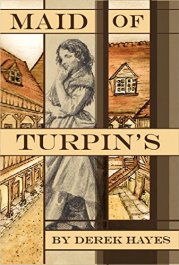
An Interview with Derek Hayes, author of Maid of Turpin’s
As regular Linda’s Book Bag readers
know, I’m always happy to support less well known authors and
publishers so it gives me great pleasure to introduce Derek Hayes today.
Derek’s latest book Maid of Turpin’s was published by Bretwalda Books on 16th July 2016. Maid of Turpin’s is available for purchase here.
Maid of Turpins

The year is 1720 and the government of Prime Minister Robert Walpole is overwhelmed by a criminal scandal which threatens to bankrupt the country. Richard Hamilton secret agent of the crown is sent to investigate. The story centres around the notorious tavern in Honey Lane; a lawless neighbourhood within Cheapside.
Turpin’s is ruled by a feisty young Sybil Turpin; an eccentric character who bathes daily in a hogshead barrel and rides like a highwayman.
She and Richard, himself an unconventional character, start as adversaries but when more brutal criminal activity unfolds, they join forces and their quest leads them around the streets of London, from Tyburn to the Bank of England; through Vauxhall Pleasure Gardens to a prison vault under London Bridge.
Richard Hamilton may have met his match with this bold young woman but the Maid of Turpin’s has a further challenge ahead, far beyond her comprehension or ability.
An Interview with Derek Hayes
Hi Derek. Thank you so much for agreeing to answer some questions on my blog about your writing. Firstly, please could you tell me a little about yourself?I’d describe myself as a well-fed bookworm, people-watcher, storyteller and an expert at make believe. They are lifelong attributes and still as useful now as they ever were. I read a lot and have quite diverse tastes. I usually have two or three books on the go at the same time.
I was a child of the fifties, but I hasten to add a very young one. I live in Wiltshire with my wife Jennifer and lots of grandchildren nearby; still able to indulge the story telling. I spent most of my working life in the NHS and that was where the people-watching began. It was always a privilege being present through the critical times of other people’s life experiences; often of the dramatic and terminal kind. But then there was hospital humour; usually itself profoundly unnerving but always a palliative for the distress and sadness. Experience enough for several lifetimes.
(I bet!)
And tell us a bit about your Langford series of books.

You can read the entire interview HERE
https://lindasbookbag.com/2016/12/10/an-interview-with-derek-hayes-author-of-maid-of-turpins/
Friday, 2 December 2016
First ebook sale of December - Winter God: The Authorised Biography of Father Christmas
Buy your copy HERE
Some people call him Father Christmas, other people name him Santa Claus, but whatever name he goes by we all know him.
He is the jolly, fat man who comes out only on Christmas Eve. He loads his sleigh up with toys for all the good children in the world. He wraps himself up in a warm, fur-lined suit of red cloth with matching hat and warm black boots. Then he hitches up his magic flying reindeer, leaves behind his workshop at the North Pole and takes to the skies. For hours he gallops across the wintry, frozen landscapes to bring toys to millions of excited children around the world.
He has become the living embodiment of the Christmas Spirit. But where did this loveable old boy come from? How old is he? Has he always been so jovial? And what about the elves, reindeer and North Pole?
Many people think that Santa was invented for an advertising campaign by Coca Cola. Others date him to Victorian times. A few may place him back in the 18th century or even Tudor times. But they are all wrong.
He is much, much older than that.
This book traces the development of our favourite Christmas character from his origins many centuries ago down to the present day. We learn when and how he started giving presents to children, why he is so fat and where the reindeer came from - among many other things.
Some people call him Father Christmas, other people name him Santa Claus, but whatever name he goes by we all know him.
He is the jolly, fat man who comes out only on Christmas Eve. He loads his sleigh up with toys for all the good children in the world. He wraps himself up in a warm, fur-lined suit of red cloth with matching hat and warm black boots. Then he hitches up his magic flying reindeer, leaves behind his workshop at the North Pole and takes to the skies. For hours he gallops across the wintry, frozen landscapes to bring toys to millions of excited children around the world.
He has become the living embodiment of the Christmas Spirit. But where did this loveable old boy come from? How old is he? Has he always been so jovial? And what about the elves, reindeer and North Pole?
Many people think that Santa was invented for an advertising campaign by Coca Cola. Others date him to Victorian times. A few may place him back in the 18th century or even Tudor times. But they are all wrong.
He is much, much older than that.
This book traces the development of our favourite Christmas character from his origins many centuries ago down to the present day. We learn when and how he started giving presents to children, why he is so fat and where the reindeer came from - among many other things.
Subscribe to:
Posts (Atom)